
Many crypto users believe that once assets leave an exchange and move into a private wallet, they become anonymous.
That assumption is one of the most common — and costly — mistakes Canadian crypto traders make.
In reality, the Canada Revenue Agency (CRA) has built one of the most detailed crypto audit frameworks in the country. Through exchange data, blockchain analysis, banking reports, and international information sharing, the CRA can often trace crypto activity far beyond what taxpayers expect.
This article breaks down how the CRA links your identity to crypto wallets, what they can and cannot see, and what happens if you’re audited — based on real CRA audit practices.
The Myth of Crypto Anonymity
Crypto wallets feel private because they don’t display names — only long strings of letters and numbers.
But crypto is pseudonymous, not anonymous.
Every transaction on most blockchains is permanently public. Anyone can see what a wallet does — even if they don’t know who owns it yet.
The CRA doesn’t need to “hack” your wallet.
They only need one connection point between you and the blockchain.
And most people create that connection without realizing it.
Where the CRA Gets the First Link: Exchanges
Crypto audits almost always begin with exchanges.
When you open an account on a Canadian or major international exchange that verifies identity, the platform collects:
- Your name, address, and government ID
- Your complete trading history
- Deposit and withdrawal addresses
That third item is critical.
When you withdraw crypto from an exchange, the platform records exactly which wallet received it.
That wallet address becomes the bridge between your identity and the public blockchain.
Real CRA Enforcement Examples
Coinsquare (2021):
The CRA obtained a Federal Court order compelling Coinsquare to hand over customer data for accounts over $20,000 between 2014–2020.
Over 16,000 customers were affected.
Dapper Labs / NBA Top Shot (2023):
The CRA again compelled disclosure, reinforcing that crypto platforms are not beyond CRA reach.
These cases established a clear precedent:
The CRA can force exchanges to provide detailed customer data.
What Happens After the Wallet Is Identified
Once a wallet address is linked to a taxpayer, the CRA can analyze everything that wallet does on-chain, including:
- All transactions and transfers
- Historical balances
- Trading frequency and volume
- Staking rewards and mining income
- Interactions with DeFi platforms
- Transfers to other wallets or exchanges
- Use of privacy tools or mixers
The CRA uses blockchain analysis tools similar to those used by tax authorities and enforcement agencies worldwide.
They cannot access your private keys — but they don’t need to.
Why Some Crypto Accounts Get Audited
Not every crypto user is audited.
But CRA scrutiny typically increases when they see:
#1: Large or unusual activity
High trading volume, frequent transactions, or sudden spikes
#2: Unreported income
Staking rewards, mining income, airdrops, or DeFi yields not included on tax returns
#3: Red-flag behaviour
Use of foreign exchanges, privacy tools, inconsistent reporting, or mismatches between bank deposits and reported income
The CRA has publicly stated that its crypto compliance work has already identified over $100 million in unpaid taxes — and that figure continues to grow.
What the CRA Can’t Fully Track (Yet)
There are still gaps — but they are narrowing quickly.
#1: Truly Off-Exchange Crypto
If crypto was acquired peer-to-peer with cash and never touched an exchange or bank, the CRA may not know that wallet exists.
However, the moment crypto touches an exchange or a bank, tracing becomes possible.
#2: Privacy Coins
Coins like Monero are extremely difficult to trace — but their use is treated as a major red flag.
If identified, CRA auditors often assume concealment and scrutinize more aggressively.
#3. DeFi Platforms
DeFi does not require ID, but transactions are still public.
If the CRA links the wallet through an exchange, DeFi activity becomes visible retroactively.
The Real Chokepoint: Canadian Banks
Most taxpayers are not caught on-chain.
They’re caught when crypto turns into Canadian dollars.
When large amounts flow from exchanges into Canadian bank accounts:
- Banks may file reports with FINTRAC
- Those reports generate audit leads
- The CRA matches bank data to tax returns
If significant crypto proceeds appear in your bank account without corresponding reported income, that discrepancy often triggers an audit.
You can trade crypto for years — but once it hits a bank account, you are visible.
International Reporting Is Expanding (CARF)
Using offshore exchanges is no longer a long-term solution.
Canada has signed onto the Crypto-Asset Reporting Framework (CARF), an international reporting system similar to bank reporting.
- Canada signed in 2024
- First reporting applies to 2026 activity
- Broad international data sharing is expected by 2027
CARF significantly expands the third-party data the CRA can receive from foreign crypto platforms.
The direction is clear:
Offshore platforms are becoming less of a hiding place.
Inside a CRA Crypto Audit: The 54 Questions
By the time the CRA contacts a taxpayer, they have usually already reviewed data and identified a recovery opportunity.
Crypto audits include:
- A 13-page questionnaire
- 54 detailed questions, including:
- When and how you entered crypto
- Whether you mined, taught, or operated crypto businesses
- Wallet addresses used
- Use of mixers or swap platforms
- Coins owned and acquisition dates
In real audits, the CRA:
- Traces wallet activity
- Cross-references exchange data
- Reviews blockchain records
- Compares responses for consistency
Here’s what it looks like when CRA actually does the work:
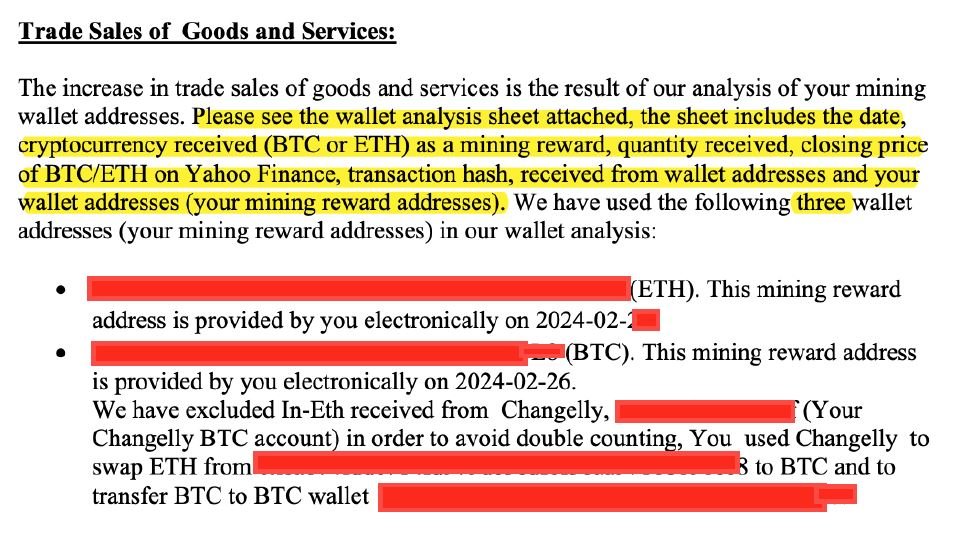
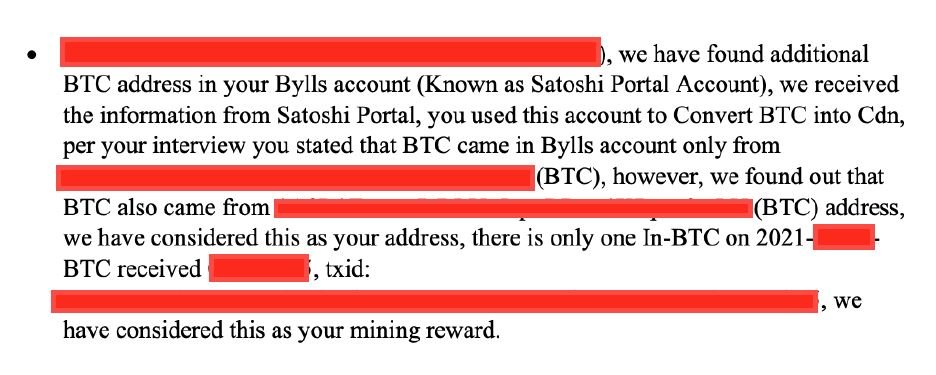
This is one of our real audit files – redacted for privacy purposes. CRA analyzed three wallet addresses. They traced ETH mining rewards. They found Changelly swaps. They cross-referenced what the taxpayer said in their interview — and caught an inconsistency.
They are not guessing.
They are building a case.
Investor vs. Business: Why It Matters
One of the CRA’s key determinations is whether crypto activity is:
- Investment activity, or
- Business income
This affects:
- When income is taxed
- Whether expenses are deductible
- The overall tax rate
Mining, in particular, receives close scrutiny under this analysis.
Audit Survival Checklist
If you are audited, preparation and consistency matter more than speed.
Key steps:
- Build one master timeline
- List every exchange, wallet, and DeFi platform used
- Export statements properly (not screenshots)
- Use Canadian dollar values at transaction dates
- Decide early: investor or business
- Identify red flags before the CRA does
Inconsistencies across emails, calls, and documents are often worse than calculation errors.
Possible Outcomes of a Crypto Audit
There are four common outcomes:
- No changes
- Reassessment plus interest
- Gross negligence penalties (50% of tax owing)
- Criminal investigation (rare, but real)
What to Do If You’re Not Compliant
If you are behind on crypto reporting, there are two options:
Option 1: Voluntary Disclosure
- Come forward before CRA contacts you
- Pay tax and interest
- Avoid penalties
To explore how the Voluntary Disclosure Program works and what it could mean for your situation, watch our in-depth discussion here:
Option 2: Wait and hope
With exchange data, blockchain tracing, bank reporting, and CARF coming online, this is a risky strategy.
Once the CRA contacts you, voluntary disclosure is no longer available.
Crypto Tax Survival Guide
If you’re looking for practical guidance on crypto tax reporting, audits, and record-keeping, download my Crypto Tax Survival Guide here:

Final Thoughts
- Crypto audits are no longer theoretical.
- They are detailed, data-driven, and increasing in frequency.
- If you are compliant, keep strong records and continue tracking carefully.
- If you are not, addressing issues early is far less costly than waiting.
- Understanding how the CRA actually tracks crypto is the first step to protecting yourself.


